
Haemostatic embolisation (stopping severe bleeding)
Surgeries/Vascular/Haemostatic embolisation

Haemostatic embolisation (stopping severe bleeding)

Haemostatic embolisation in Tunis, Tunisia · Centre Urbain Nord

Stopping severe bleeding by blocking the bleeding artery from the inside, often as an emergency and without surgery.

What is it?

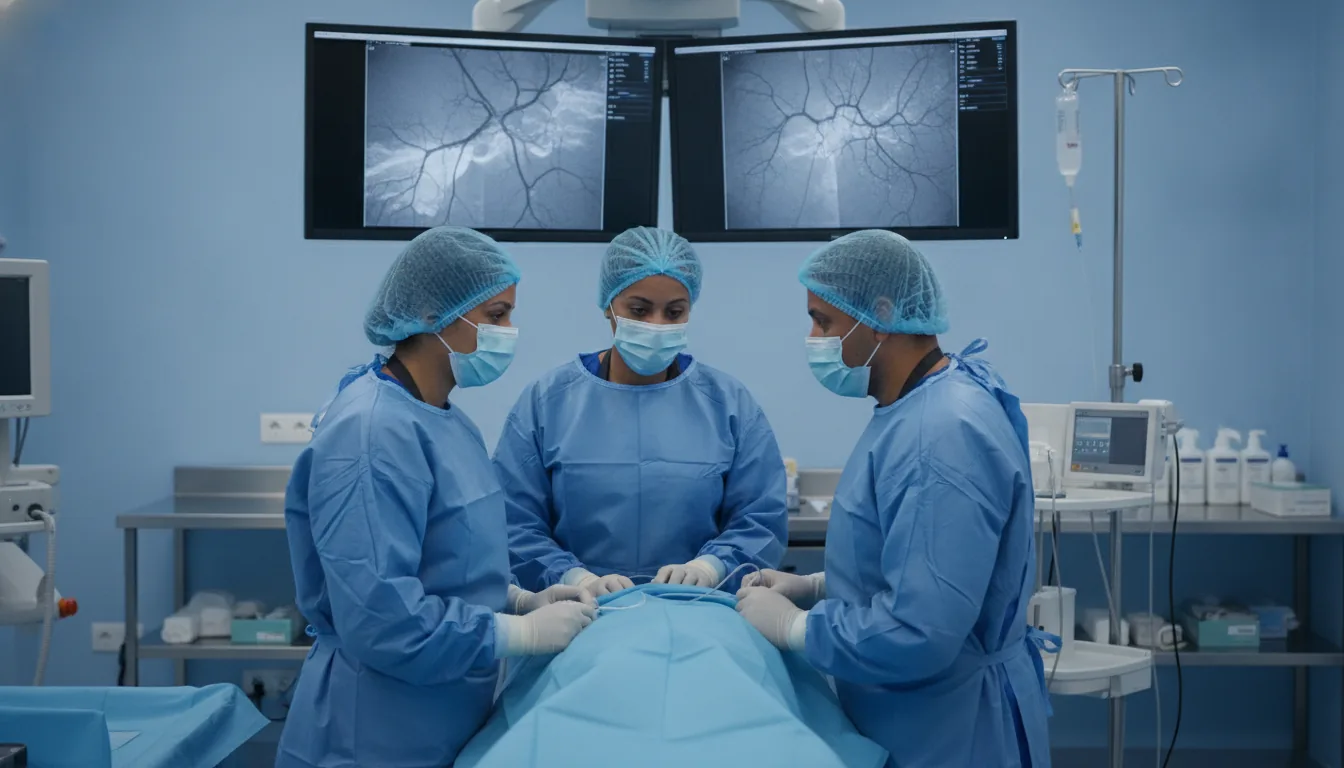
Some types of bleeding are hard to control with usual measures: bleeding after childbirth, after an injury, from the digestive tract, from the lungs (coughing up blood), from the kidney or after a procedure. Haemostatic embolisation involves finding the bleeding artery with arteriography, then blocking it from the inside to stop the haemorrhage. The procedure is performed in the catheterisation laboratory, most often as an emergency, under local or general anaesthesia depending on the patient's condition. A catheter is introduced through the groin or wrist and guided to the artery concerned. Depending on the situation, particles, small metal coils, glue or a temporary plugging agent are used. This technique often avoids major surgery or allows an organ to be preserved, for example the uterus after childbirth. It is part of coordinated emergency care involving emergency physicians, intensive care specialists, surgeons and interventional physicians. At Clinique Pasteur Tunis, the close links between the emergency department, intensive care, the operating theatre and the latest-generation catheterisation laboratory make it possible to organise this procedure quickly.
Haemostatic embolisation (stopping severe bleeding)

When is it indicated?

Bleeding after childbirth

When bleeding continues despite medication, blocking the uterine arteries can stop it while preserving the uterus.

Bleeding after an injury

In a pelvic fracture or an injury to the liver, spleen or kidney, embolisation stops the bleeding without opening.

Coughing up large amounts of blood (haemoptysis)

This often comes from the bronchial arteries, which can be blocked via a catheter.

Digestive bleeding not controlled by endoscopy

If endoscopy cannot stop bleeding from the stomach or intestine, embolisation is an effective option.

Bleeding after a procedure or biopsy

A small artery injured during a procedure can be closed quickly by the endovascular route.

Preparation

1Emergency care: infusion, transfusion if needed, continuous monitoring
2Contrast CT scan when the condition allows, to locate the bleeding
3Urgent blood tests (blood count, clotting, blood group)
4Information given to the patient or their family about the procedure

Procedure

1

Positioning in the catheterisation laboratory with continuous monitoring

2

Local or general anaesthesia depending on the patient's condition

3

Puncture of the artery and arteriography to find the source of bleeding

4

Approach to the artery concerned with a very fine catheter

5

Closure of the artery with particles, coils or glue

6

Check that the bleeding has stopped and return to intensive or high-dependency care

Duration

1 to 2 hours depending on the situation

Aftercare & Recovery

Recovery depends on the cause of the bleeding. Close monitoring is provided, often in intensive care, with haemoglobin checks. The length of stay is that of the underlying condition. If bleeding recurs, a further procedure can be performed.

Risks and side effects

Recurrence of bleeding requiring a further procedure or surgery
Reduced blood supply to the organ whose artery was closed, usually limited
Effect on kidney function due to the contrast dye
Bruising at the puncture site

These risks remain rare. Your surgeon will inform you in detail before the procedure.

Request a Quote

Contact us to schedule a consultation or receive a personalized quote.

Request a Quote +216 36 402 000

At a glance

Duration: 1 to 2 hours depending on the situation
Preparation: Required
Dedicated specialist team

Related searches

  • Haemostatic embolisation Tunis
  • Haemostatic embolisation Tunisia
  • Haemostatic embolisation in Tunisia
Request a quote