
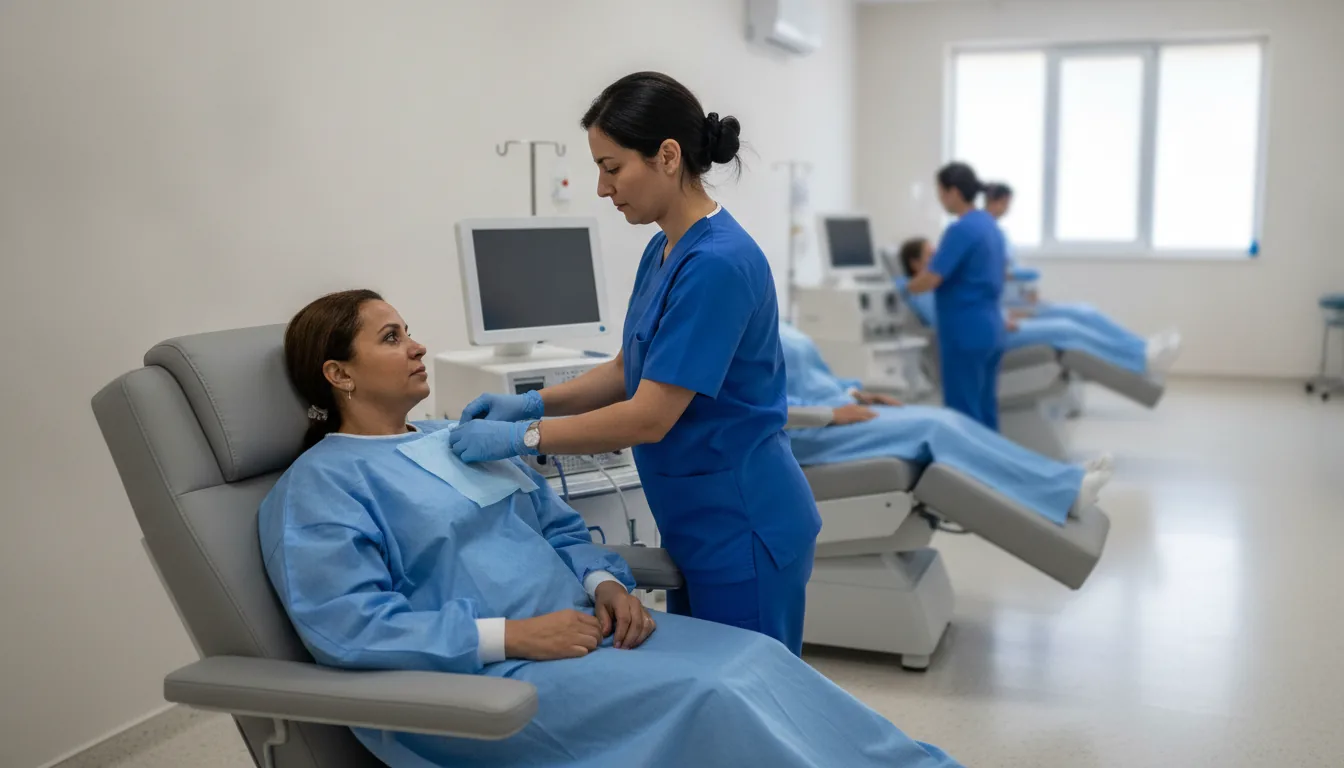
Tunnelled dialysis catheter insertion
Dialysis catheter in Tunis, Tunisia · Centre Urbain Nord
Placement of a catheter in a large neck vein, routed under the skin, allowing haemodialysis without a fistula.
What is it?
When is it indicated?
When dialysis must start quickly, the catheter allows it to begin immediately.
The catheter provides dialysis during the weeks the fistula needs to develop.
After several fistulas, sometimes no arm vein is usable any more: the catheter then becomes the dialysis access.
In some patients, particularly those with a fragile heart, a fistula is not desirable and a catheter is preferred.
Preparation
Procedure
Lying down with the head turned to the opposite side
Skin disinfection, sterile drapes and local anaesthesia
Ultrasound-guided puncture of the jugular vein
Creation of the tunnel under the skin to the upper chest
Positioning of the catheter under fluoroscopic guidance
Securing, flushing both lumens and dressing
Duration
30 to 45 minutes
Aftercare & Recovery
Insertion is usually done as day surgery or during a hospital stay for dialysis. The catheter can be used immediately. The dressing is changed by the dialysis team under sterile conditions; it must not get wet or be handled. Any fever or shivering, especially during a session, should be reported straight away. The catheter is removed once the fistula is working.
Risks and side effects
These risks remain rare. Your surgeon will inform you in detail before the procedure.
Request a Quote
Contact us to schedule a consultation or receive a personalized quote.
Request a Quote +216 36 402 000At a glance
Related searches
- Dialysis catheter Tunis
- Dialysis catheter Tunisia
- Dialysis catheter in Tunisia