
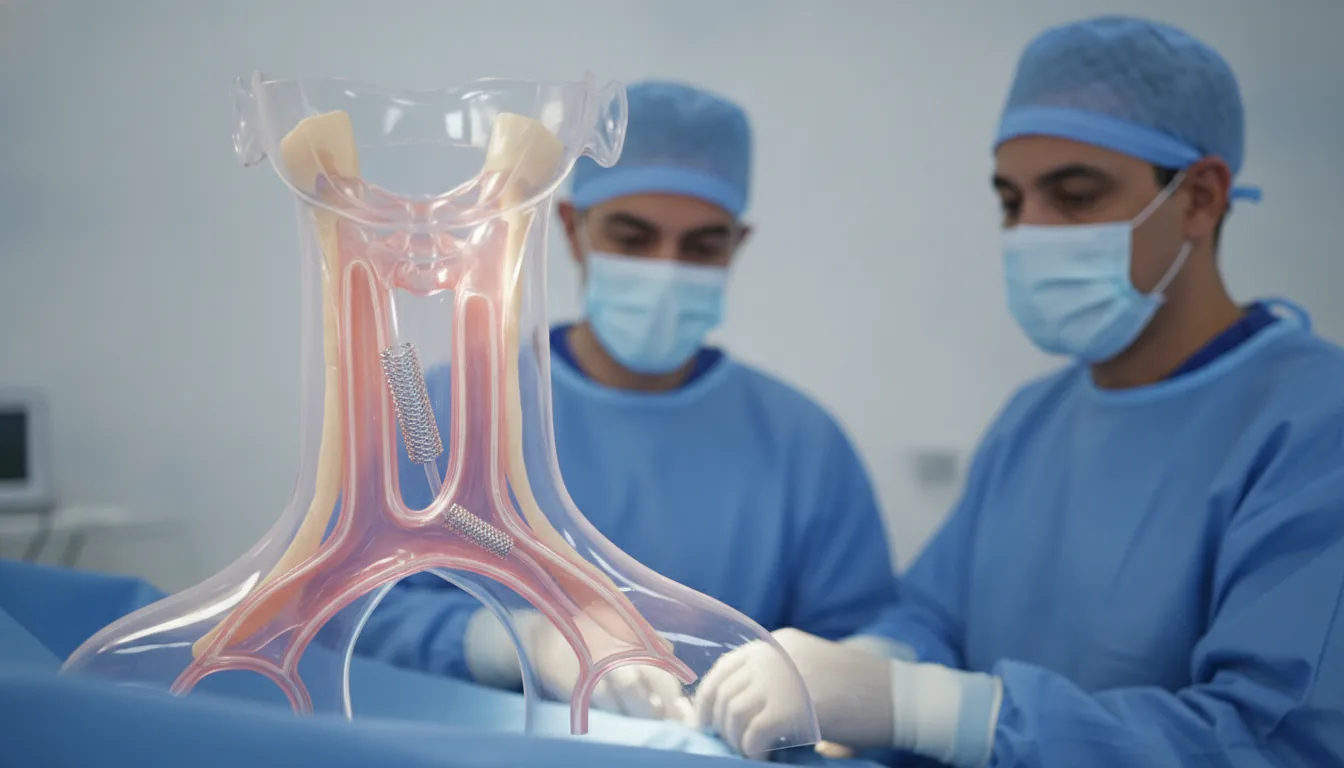
Carotid angioplasty and stenting
Surgeries/Vascular/Carotid stent

Carotid angioplasty and stenting

Carotid stent in Tunis, Tunisia · Centre Urbain Nord

Treatment of a narrowed carotid artery with a stent placed from inside the artery, to reduce the risk of stroke.

What is it?

The carotid arteries, on each side of the neck, supply blood to the brain. An atheroma plaque can narrow them and release small fragments that cause a stroke. Carotid angioplasty involves placing a stent inside the artery that presses the plaque against the wall and restores a good diameter. The procedure is performed in the catheterisation laboratory under local anaesthesia, which allows the team to check continuously that the patient can speak and move normally. The catheter is introduced in the groin or at the wrist and advanced up to the neck. A protection system (a small filter or temporary flow blockage) is generally used to stop debris from travelling to the brain. Open surgery (endarterectomy) often remains the standard treatment for carotid narrowing. Stenting is offered in specific situations: a neck that has already been operated on or irradiated, a lesion that is difficult to reach, or a patient at high surgical risk. The decision is made jointly by the neurologist, the vascular surgeon and the interventional physician. At Clinique Pasteur Tunis, the procedure is performed in a latest-generation catheterisation laboratory, with close neurological and cardiac monitoring afterwards.
Carotid angioplasty and stenting

When is it indicated?

Carotid narrowing that has already caused symptoms

A stroke or transient ischaemic attack (a temporary problem with speech, vision or strength) linked to the carotid artery carries a risk of recurrence: treating the lesion reduces that risk.

Severe narrowing without symptoms, in some cases

When the narrowing is very tight, treatment may be considered to prevent a stroke, after careful assessment of benefits and risks.

Neck previously operated on or treated with radiotherapy

In these situations open surgery is more difficult; working from inside the artery is often safer.

High risk for open surgery

Some heart or lung conditions make general anaesthesia riskier; stenting under local anaesthesia may then be preferred.

Preparation

1Consultation with the neurologist and interventional physician, review of the Doppler and CT or MRI
2Dual antiplatelet therapy started a few days before, as prescribed
3Blood tests including kidney function and clotting, and an electrocardiogram
4Report any iodine allergy
5Fast for a few hours before the procedure

Procedure

1

Positioning in the catheterisation laboratory with blood pressure and heart rhythm monitoring

2

Local anaesthesia and puncture of the artery in the groin or at the wrist

3

Advancement of the catheter to the carotid artery under X-ray guidance

4

Placement of a cerebral protection system

5

Deployment of the stent, with balloon dilatation if needed

6

Check of the images and neurological status, then closure of the puncture site

Duration

About 1 to 1.5 hours

Aftercare & Recovery

Close monitoring is provided on the first day, and the hospital stay is generally 1 to 2 days. Usual activities resume within a few days. Antiplatelet treatment is continued as prescribed and a follow-up Doppler scan is scheduled. Controlling blood pressure and cholesterol and stopping smoking remain essential.

Risks and side effects

Stroke during or after the procedure, uncommon, hence the precautions taken
Temporary drop in blood pressure or heart rate, monitored and treated
Bruising at the puncture site
Re-narrowing later on, monitored by Doppler

These risks remain rare. Your surgeon will inform you in detail before the procedure.

Request a Quote

Contact us to schedule a consultation or receive a personalized quote.

Request a Quote +216 36 402 000

At a glance

Duration: About 1 to 1.5 hours
Preparation: Required
Dedicated specialist team

Related searches

  • Carotid stent Tunis
  • Carotid stent Tunisia
  • Carotid stent in Tunisia
Request a quote