
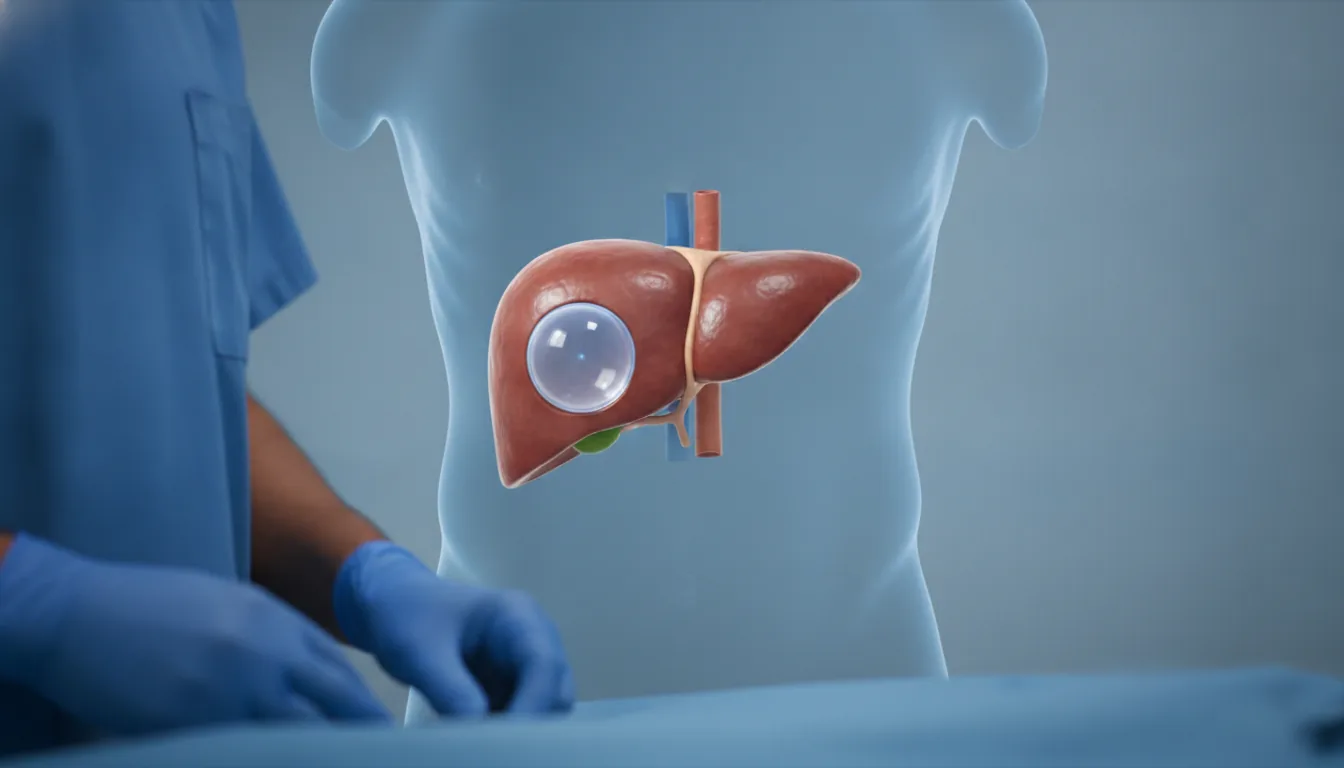
Surgery for hydatid cyst of the liver
Surgeries/General/Hydatid cyst of the liver

Surgery for hydatid cyst of the liver

Hydatid cyst of the liver in Tunis, Tunisia · Centre Urbain Nord

Surgical treatment of hydatid cyst of the liver, by laparoscopy or open surgery, while preventing any spread of the parasite.

What is it?

Hydatid cyst (cystic echinococcosis) is a parasitic disease common in North Africa. It is caused by the larva of a small dog tapeworm (Echinococcus granulosus): people become infected through contaminated food or hands. In the liver, sometimes in the lung or other organs, the larva forms a fluid-filled pouch that grows slowly over years. Surgical treatment aims to remove the parasite without spreading it in the abdomen. The operating field is protected with swabs soaked in a product that kills the parasite, the cyst is punctured and sterilised, and its contents are removed. The surgeon then removes the protruding part of the cyst wall (unroofing) or, when possible, the whole cyst with its outer layer (pericystectomy). Any communication with the bile ducts is looked for and closed. Depending on location, the operation is performed laparoscopically or through open surgery. Surgery is offered for active, large or complicated cysts (infection, rupture into the bile ducts) or those located near important structures. Some small inactive or calcified cysts can simply be monitored. Antiparasitic tablets (albendazole) are often given before and after surgery. At Clinique Pasteur Tunis, the assessment includes ultrasound, CT or MRI and serology. The operation is carried out by a team familiar with this condition, which is common in the region, with ultrasound follow-up after surgery.
Surgery for hydatid cyst of the liver

When is it indicated?

Active or large hydatid cyst

A living cyst that is growing is likely to cause complications; removing it prevents them.

Cyst ruptured into the bile ducts

If the cyst contents pass into the bile ducts, they can cause jaundice and infection; surgery treats the cyst and clears the ducts.

Infected cyst

An infected cyst behaves like an abscess and must be treated surgically, together with antibiotics.

Cyst compressing nearby organs

A cyst close to major blood vessels or bile ducts can compress them and cause symptoms.

Preparation

1Ultrasound, CT scan or MRI of the liver
2Hydatid serology and liver blood tests
3Chest X-ray or CT scan to look for a lung cyst
4Antiparasitic treatment (albendazole) before surgery depending on the case
5Anaesthetic consultation
6Fast for 6 hours before surgery

Procedure

1

General anaesthesia

2

Laparoscopy or incision under the right ribs

3

Protection of the operating field with swabs soaked in an antiparasitic solution

4

Puncture and sterilisation of the cyst, then suction of its contents

5

Unroofing or complete removal of the cyst

6

Search for and closure of any communication with the bile ducts

7

Drainage of the residual cavity and closure

Duration

1 hour 30 minutes to 3 hours

Aftercare & Recovery

The hospital stay usually lasts 3 to 7 days, depending on the size of the cyst and the drainage. Antiparasitic treatment continues for a few weeks after surgery. Follow-up ultrasounds are performed for several years to make sure there is no recurrence.

Risks and side effects

Bile leaking through the drain (biliary fistula), which usually dries up on its own
Infection of the residual cavity
Allergic reaction to the cyst fluid, rare, prevented by precautions during surgery
Recurrence or a new cyst, hence ultrasound follow-up

These risks remain rare. Your surgeon will inform you in detail before the procedure.

Request a Quote

Contact us to schedule a consultation or receive a personalized quote.

Request a Quote +216 36 402 000

At a glance

Duration: 1 hour 30 minutes to 3 hours
Preparation: Required
Dedicated specialist team

Related searches

  • Hydatid cyst of the liver Tunis
  • Hydatid cyst of the liver Tunisia
  • Hydatid cyst of the liver in Tunisia
Request a quote