
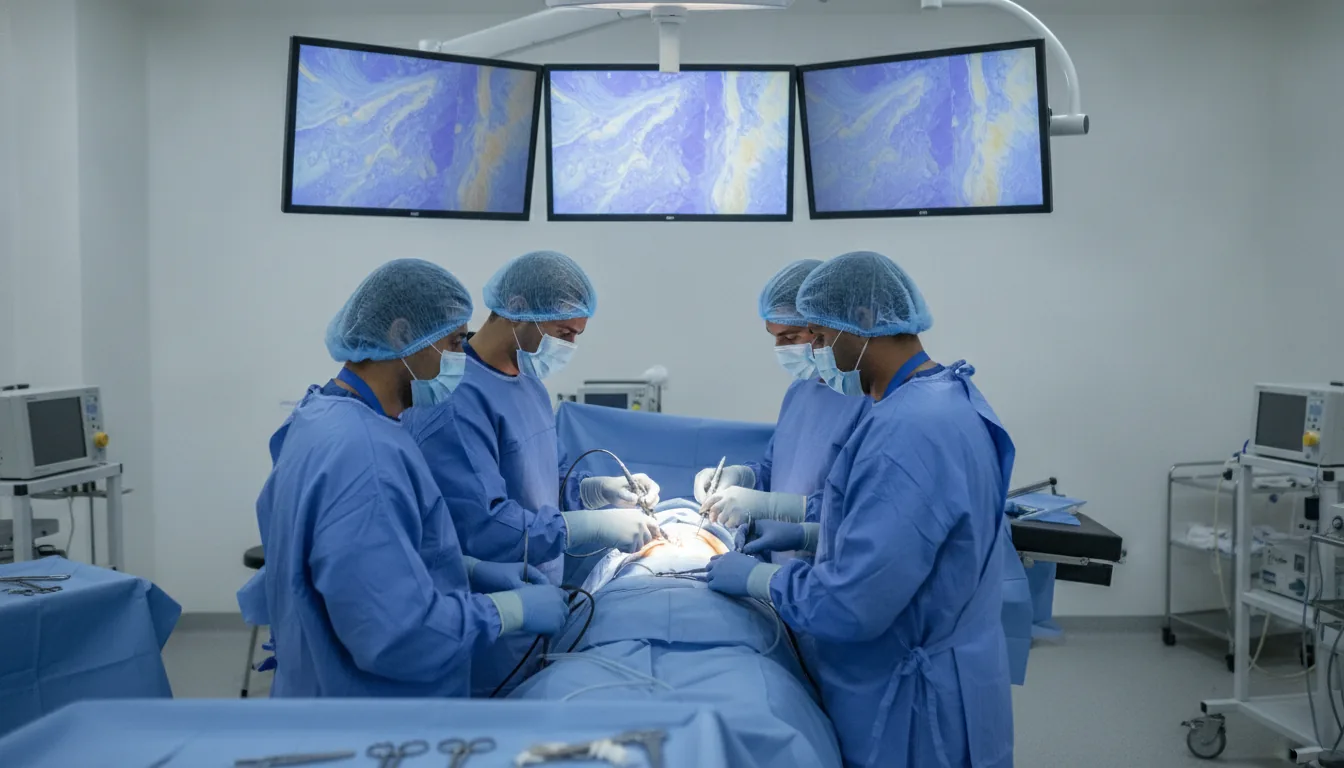
Umbilical and epigastric hernia repair
Surgeries/General/Umbilical hernia

Umbilical and epigastric hernia repair

Umbilical hernia in Tunis, Tunisia · Centre Urbain Nord

Repair of a hernia at the navel or along the midline of the abdomen, with or without mesh depending on its size.

What is it?

An umbilical hernia is a small bulge at the navel: some abdominal fat, sometimes bowel, passes through an opening that has remained too wide. An epigastric hernia (hernia of the linea alba) is very similar, located on the midline above the navel. They are encouraged by excess weight, pregnancies, chronic cough or repeated strain. In adults, they do not close on their own. For a small hernia, a short incision at the edge of the navel is enough: the contents are pushed back and the opening closed with strong stitches. As soon as the opening is a little wider, the wall is reinforced with a soft mesh placed behind the muscles, which markedly reduces the risk of recurrence. Some hernias, particularly when associated with separation of the rectus muscles (diastasis), can be repaired laparoscopically. Surgery is offered when the hernia is painful, getting bigger, bothersome in daily life or has already become stuck. It prevents strangulation, which is rare but requires emergency surgery. At Clinique Pasteur Tunis, this operation is usually done as a short stay. The surgeon chooses the technique according to the size of the opening, body weight and the person's plans (a future pregnancy, for example, should be mentioned).
Umbilical and epigastric hernia repair

When is it indicated?

Painful or bothersome bulge at the navel

A navel hernia that hurts, pulls on exertion or gets in the way when dressing can be repaired simply.

Hernia that grows over time

The smaller the opening at the time of surgery, the simpler and stronger the repair.

Epigastric hernia

A bulge on the midline above the navel is repaired using the same principles as an umbilical hernia.

Previous episode of the hernia becoming stuck

If the hernia has already stayed hard and painful for a while, it is better to repair it soon to avoid strangulation.

Preparation

1Consultation with the surgeon and examination of the abdominal wall
2Ultrasound or CT scan of the wall if needed
3Blood tests and anaesthetic consultation
4Mention any plans for pregnancy and any anticoagulant treatment
5Fast for 6 hours before surgery

Procedure

1

General anaesthesia, sometimes regional anaesthesia

2

Short incision in the fold of the navel, or small laparoscopic incisions

3

Return of the hernia contents into the abdomen

4

Closure of the opening, reinforced with a mesh if needed

5

Reshaping of the navel

6

Dressing, and getting up the same day

Duration

30 minutes to 1 hour 30 minutes

Aftercare & Recovery

Discharge is the same day or the next day. Daily activities resume quickly; lifting heavy loads and abdominal effort are avoided for about four weeks. An abdominal binder may be recommended. The surgeon sees the patient again to check healing.

Risks and side effects

Pain and swelling around the navel for a few days
Bruising or seroma, usually without consequence
Delayed healing or local infection, especially in smokers or people with diabetes
Possible recurrence, less frequent when a mesh is used

These risks remain rare. Your surgeon will inform you in detail before the procedure.

Request a Quote

Contact us to schedule a consultation or receive a personalized quote.

Request a Quote +216 36 402 000

At a glance

Duration: 30 minutes to 1 hour 30 minutes
Preparation: Required
Dedicated specialist team

Related searches

  • Umbilical hernia Tunis
  • Umbilical hernia Tunisia
  • Umbilical hernia in Tunisia
Request a quote