
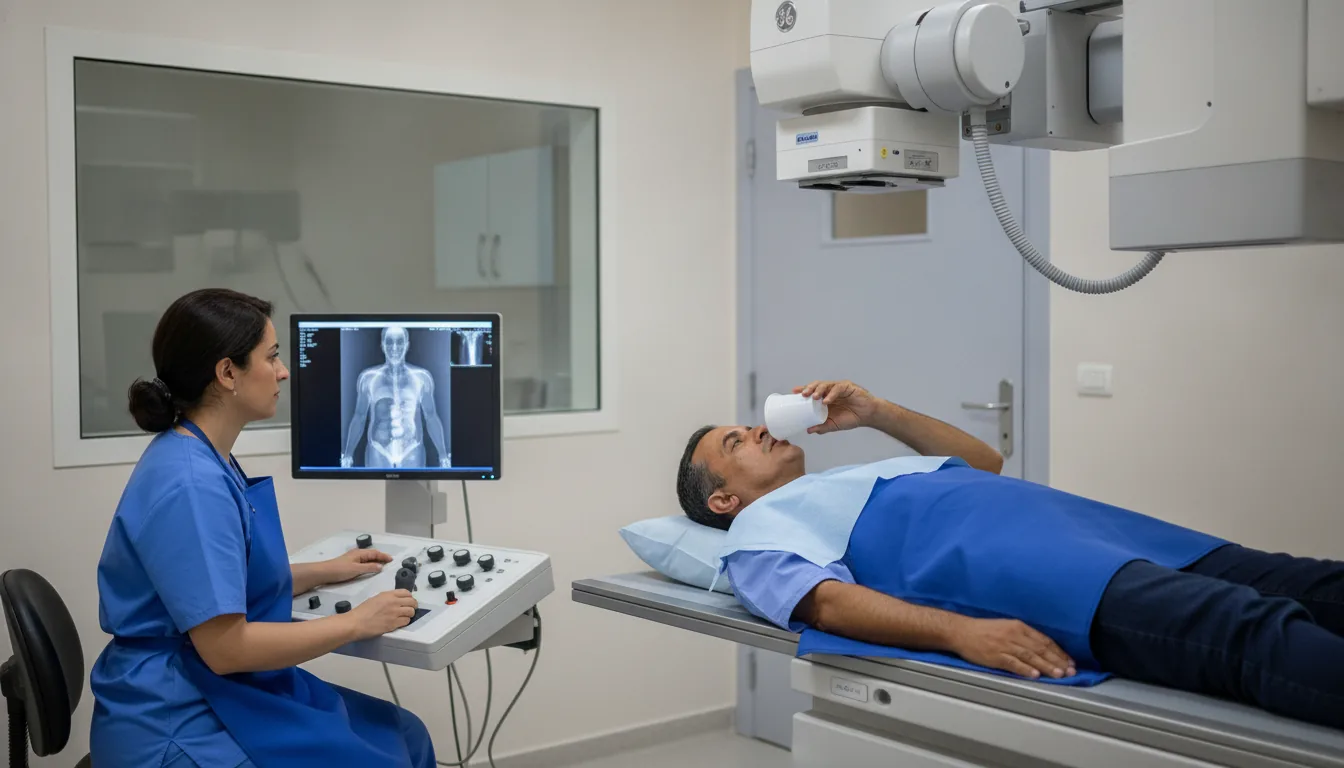
Cholangiography (contrast study of the bile ducts)
Cholangiography in Tunis, Tunisia · Centre Urbain Nord
Cholangiography in Tunis: X-ray of the bile ducts with iodinated contrast, usually through a drain placed after surgery.
What is it?
When is it indicated?
It checks that bile flows into the intestine and that no stone remains in the ducts.
After gallbladder or bile duct surgery, it looks for a stone that was left behind.
It may show a leak at a bile duct suture.
The transhepatic route may be used when an obstruction blocks bile flow and another route is not possible.
Preparation
Procedure
You remove clothing and metal objects from the area being examined, in a changing cubicle
You lie on your back on the X-ray table
Through a drain: the contrast is gently injected into the drain, without a needle
Transhepatic route: after local anaesthesia, the radiologist inserts a fine needle through the skin into the bile ducts
The radiologist follows the contrast agent live on a screen (fluoroscopy) and takes images at the right moments
After a transhepatic procedure, a few hours of monitoring are planned
Duration
About 15 to 30 minutes through a drain; longer for a transhepatic procedure
Results
The images are analysed by a radiologist, who writes a report. It is given to you with the images and sent to your doctor, who will explain the results and the next steps. You will be told on the day of the examination when the results will be ready.
Precautions and contraindications
Your doctor and the radiology team will inform you in detail before the examination. Feel free to ask them your questions.
This information is general and does not replace the advice of your doctor, who chooses the examination suited to your situation.
Other examinations — Conventional radiology
All examinationsRelated searches
- Cholangiography Tunis
- Cholangiography Tunisia
- Cholangiography in Tunisia