
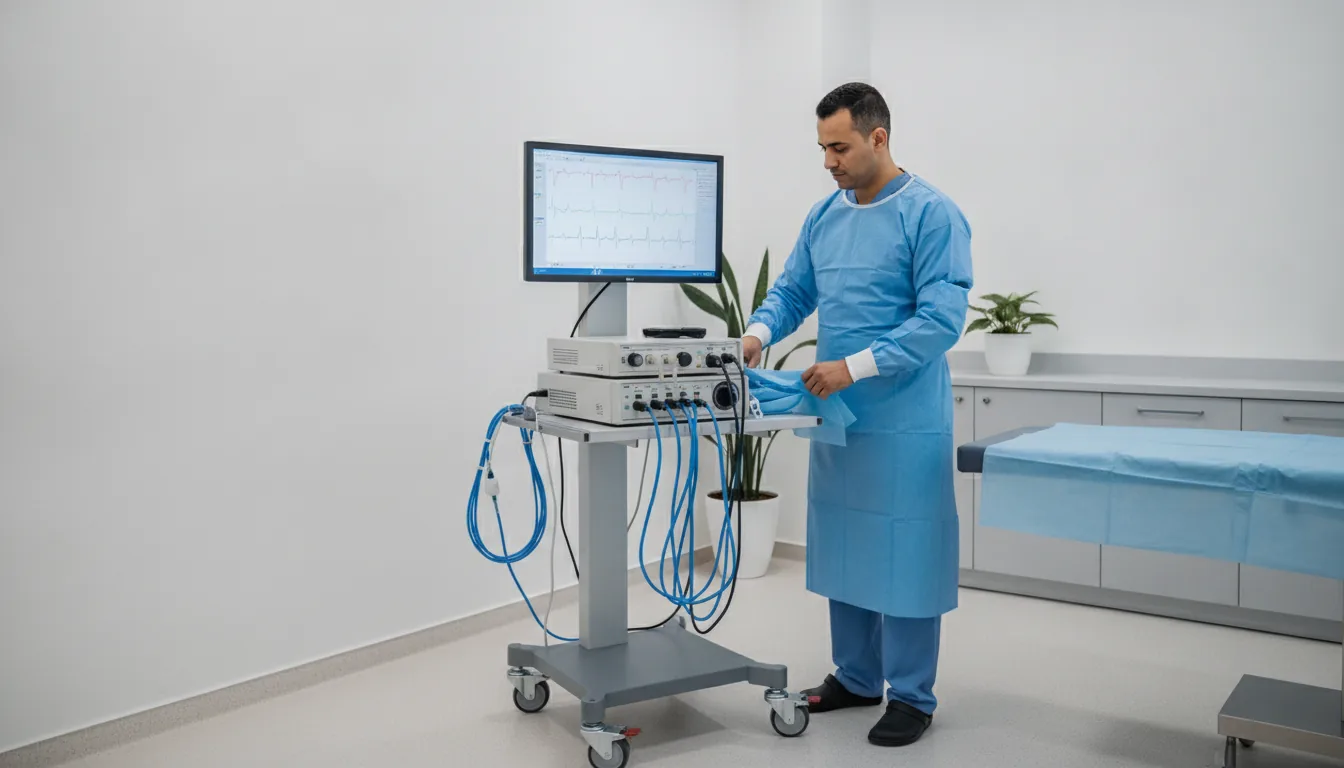
What is urodynamic testing?
Urodynamic testing, sometimes called a urodynamic assessment, brings together several tests that study how the bladder fills, holds urine and then empties. It focuses on the lower urinary tract: the bladder, the urethra and the sphincter that keeps you continent.
Unlike an ultrasound or a CT scan, which show the shape of the organs, urodynamic testing measures how they work. It records pressures and flow while the bladder fills and while you pass urine. These measurements help the doctor understand symptoms that questioning and clinical examination cannot always explain.
The term can refer to a simple test, such as uroflowmetry, or to a complete assessment combining several tests during the same session. Your doctor chooses the tests that are useful for your situation.
When your doctor recommends it
Urodynamic testing is most often prescribed by a urologist, a gynaecologist or a neurologist. It does not make a diagnosis on its own: it provides additional information that helps choose the most suitable care.
It may be recommended in the following situations:
- Urine leakage (incontinence) on exertion, with sudden urges, or both.
- Frequent or urgent need to pass urine, during the day or at night.
- Difficulty passing urine: weak stream, need to strain, urinating in several goes, feeling of incomplete emptying.
- A neurological condition that can affect the bladder, such as a spinal cord injury or multiple sclerosis.
- Before prostate surgery or an operation to treat incontinence, to check how the bladder works.
- When urinary problems persist despite treatment, to reconsider the care plan.
The tests that make up the assessment
Depending on your doctor's question, urodynamic testing combines one or more of the following tests. They are often performed one after the other during a single appointment:
- Uroflowmetry: you pass urine into a device that records the strength and duration of the stream. This is often the first step.
- Post-void residual measurement: an ultrasound of the lower abdomen checks whether urine remains in the bladder after voiding.
- Cystometry: the bladder is gently filled through a thin catheter to study its sensation, capacity and any involuntary contractions.
- Urethral pressure profile: it measures the pressure exerted by the urethra and sphincter, which shows how well they close.
- Pressure-flow study: it records bladder pressure and flow at the same time while you pass urine, to tell an obstruction apart from a bladder that contracts less well.
How to prepare
Preparation is simple, but some instructions matter so that the test goes well. Personal instructions are given by your doctor and by the team when you book: they always take precedence over the general advice below.
A recent urine test (urine culture) is usually requested before the examination, to make sure there is no urinary infection. If there is an infection, the test is postponed until it has been treated.
On the day of the appointment:
- If possible, arrive with a full bladder, without forcing yourself to drink excessively: uroflowmetry is often done first.
- Bring your prescription, the urine test, your previous results (ultrasounds, reports) and, if requested, your bladder diary.
- Prepare a list of your medicines. Some medicines that act on the bladder may be paused a few days before the test, only on your doctor's advice: do not stop anything on your own.
- Mention any allergy, anticoagulant treatment or possible pregnancy.
- You can eat and drink normally unless told otherwise.
How the test is carried out
The test takes place in a dedicated room, with respect for your privacy. The healthcare professional explains each step before starting and you can ask any questions you have.
You usually begin by passing urine into the flowmeter, then the residual volume is measured by ultrasound. For the rest of the assessment, you lie down or sit in a semi-reclined position. A very thin catheter is inserted into the bladder through the natural passage, after disinfection, and a small sensor is often placed in the rectum to measure abdominal pressure. Electrodes may also be placed on the skin of the perineum.
The bladder is then slowly filled with a sterile fluid. You are asked to report your sensations: first urge to urinate, strong urge, any urgency. You may also be asked to cough or strain to see whether any leakage occurs. At the end of filling, you pass urine with the catheters in place for the pressure-flow study.
The test is not painful, but inserting the catheter can be slightly uncomfortable. A complete assessment takes longer than a simple test: allow some time that day. Do say if you feel uncomfortable: staying relaxed makes the measurements easier.
After the test and results
Once the catheters are removed, you can return to your usual activities. It is advisable to drink normally in the following hours to flush the bladder. A slight burning sensation when passing urine or a few traces of blood in the urine may appear: they usually settle quickly on their own.
See a doctor if you have a fever, persistent burning, cloudy or foul-smelling urine, or if you cannot pass urine: these signs may suggest a urinary infection and should be checked.
The measurements are summarised in a detailed report, interpreted by the doctor in light of your symptoms, clinical examination and other tests. The doctor will explain what the results show and the resulting care options: lifestyle advice, pelvic floor rehabilitation, medication or, in some cases, surgery.
Urodynamic testing at Clinique Pasteur Tunis
At Clinique Pasteur Tunis, in the Centre Urbain Nord, urodynamic testing is performed in the urodynamic exploration centre. It offers simple tests, such as uroflowmetry and post-void residual measurement, as well as complete urodynamic assessment and pre-operative assessment.
To book an appointment, have your doctor's prescription to hand and contact the clinic. The team will tell you the practical instructions to follow before the test.
Frequently asked questions
Is urodynamic testing painful?
It is not painful, but inserting the catheter into the bladder can be slightly uncomfortable, especially at first. The catheter used is very thin and the healthcare professional guides you through each step.
How long does urodynamic testing take?
It depends on the tests planned. Uroflowmetry alone takes only a few minutes, whereas a complete assessment takes longer. The team will tell you how much time to allow when you book.
Do I need to fast?
No, fasting is generally not necessary. You are often asked to arrive with a full bladder. Always follow the instructions given by your doctor and the team.
Should I stop my medicines before the test?
Some treatments that act on the bladder may be paused a few days beforehand, but only on your doctor's advice. Do not stop or change any treatment on your own.
Can I resume my activities after the test?
Yes, you can return to your usual activities straight after the test. Remember to drink well. If you have a fever, persistent burning or cannot pass urine, see a doctor.
This article is for general information only. It does not replace the advice of your doctor, who alone can adapt instructions to your situation.
Learn more
A question? A quote?
Our team answers your questions and supports you throughout your care journey.