
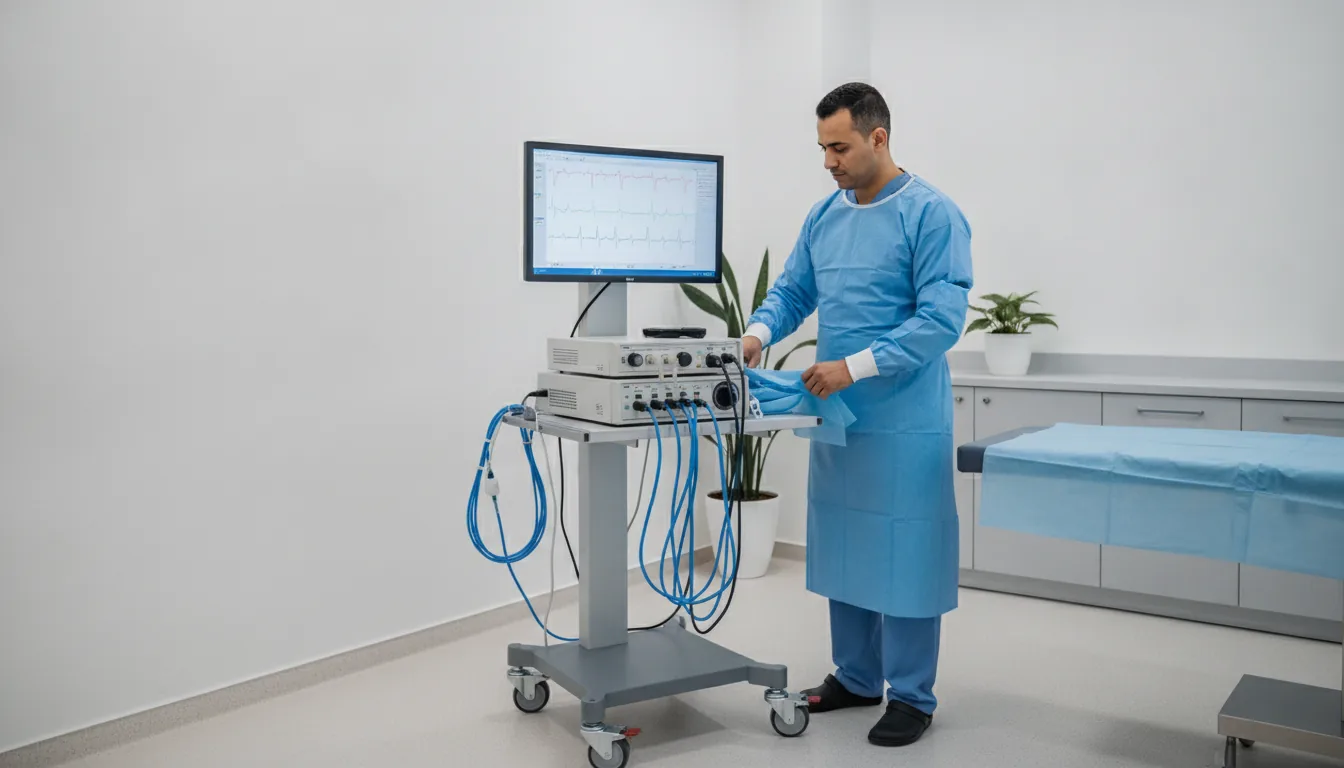
What is post-void residual urine?
Post-void residual urine, often abbreviated PVR (or RPM in French), is the amount of urine left in the bladder just after you have urinated. When the bladder works well, it empties almost completely each time. It is normal for a small volume to remain, with no consequence at all.
When the bladder does not empty completely, the urine that remains can cause discomfort: frequent urges to urinate, a feeling of incomplete emptying, the need to strain, a weak stream or repeated urinary infections. Measuring this residual volume helps the doctor understand where these symptoms come from.
Post-void residual measurement is one of the simplest urodynamic tests. It requires no catheter, no injection and no X-rays: it relies on ultrasound.
Why your doctor requests this measurement
Your urologist, gynaecologist or family doctor may prescribe this measurement in a variety of situations. Most often, it is used to check that the bladder empties properly, or to follow a urinary problem over time.
It is offered in particular in the following cases:
- Alongside uroflowmetry, the test that measures the strength of the urine stream: the two are very often performed together.
- To assess bladder emptying problems: a weak stream, urinating in several goes, a feeling of not having finished.
- To follow a person treated for urinary problems and check the effect of the treatment.
- As part of the assessment of recurrent urinary infections, since stagnant urine can encourage them.
- To monitor the bladder of people with a neurological condition.
- After prostate or pelvic surgery, to check that the bladder empties well.
How to prepare for the test
Good news: post-void residual measurement generally requires no special preparation. You do not need to fast and you can eat and drink normally.
The principle is to measure what remains in the bladder just after a natural void. It is therefore important to urinate normally, without straining and without holding back, when the team asks you to. If the measurement is combined with uroflowmetry, you will often be asked to arrive with a need to urinate: follow precisely the instructions you were given when booking your appointment.
A few practical tips for the day of the test:
- Bring your prescription and any previous tests (ultrasound scans, urology reports).
- Prepare a list of your current treatments, including those that act on the bladder or the prostate.
- Wear comfortable clothing that makes it easy to uncover your lower abdomen.
- Do not stop or change any treatment without your doctor's advice.
How the measurement is performed
You start by urinating normally, in the toilet or into the flowmeter if uroflowmetry is planned. Straight afterwards, you are asked to lie on your back: the measurement must be taken quickly, before the bladder starts to fill again.
A gel is applied to your lower abdomen, above the pubic bone. The healthcare professional then places an ultrasound probe or a dedicated device called a "bladder scanner" on it. The ultrasound shows the bladder and calculates the volume of urine still inside. With a standard ultrasound machine, several measurements are taken in different planes to estimate this volume.
The test only takes a few minutes and is completely painless. You only feel the contact of the gel, which is a little cool, and slight pressure from the probe. The result is displayed on the screen immediately. The ultrasound can also give useful information about the appearance of the bladder, such as the thickness of its wall.
Understanding the result
Post-void residual is expressed in millilitres. A small volume is considered usual. A larger volume may mean that the bladder is not emptying well, for example because of an obstruction along the urinary tract (such as an enlarged prostate in men) or a bladder that contracts less effectively.
The figure alone is not enough to make a diagnosis. The doctor interprets it taking into account your age, your symptoms, your treatments and your other tests. A single measurement can also be influenced by the circumstances, for example if urinating was difficult or unusual: this is why the doctor may sometimes ask for it to be repeated.
If the result warrants it, other tests may be offered to better understand how the bladder works, such as uroflowmetry or a more complete urodynamic assessment. It is always your doctor who decides on the next steps.
Post-void residual measurement at Clinique Pasteur Tunis
At Clinique Pasteur Tunis, in the Centre Urbain Nord, post-void residual measurement is part of the urodynamic explorations. It can be performed on its own or combined with other bladder tests, in a setting that respects your privacy.
To book an appointment, have your doctor's prescription ready and contact the clinic. The team will tell you the practical instructions to follow on the day of the test.
After the measurement, no special precautions are needed: you can return to your usual activities straight away. If you later experience burning when urinating, fever or an inability to urinate, these signs are not related to the test but should lead you to see a doctor promptly.
Frequently asked questions
Is post-void residual measurement painful?
No. It is a simple ultrasound of the lower abdomen: no catheter is inserted and no injection is given. You only feel the gel and slight pressure from the device.
Do I need to fast or have a full bladder?
You do not need to fast. The measurement is taken just after urinating. If it is combined with uroflowmetry, you will often be asked to arrive with a need to urinate: follow the instructions given when booking your appointment.
How long does the test take?
The measurement itself only takes a few minutes and the result is available immediately. If other tests are planned on the same day, allow a little more time.
What does PVR mean in urology?
PVR stands for post-void residual: the volume of urine left in the bladder after urinating. Measuring it helps the doctor know whether the bladder empties properly.
Is a high residual volume serious?
Not necessarily. A high residual volume shows that the bladder is emptying incompletely, but it must be interpreted by your doctor together with your symptoms and other tests. Only your doctor can tell you whether further tests or treatment are needed.
This article is for general information only. It does not replace the advice of your doctor, who alone can adapt instructions to your situation.
Learn more
A question? A quote?
Our team answers your questions and supports you throughout your care journey.