
Facial fat grafting in a few words
Facial fat grafting, also called lipofilling or fat transfer, involves taking a small amount of fat from an area where there is an excess, preparing it, then reinjecting it in very small quantities into the areas of the face that have become hollow.
With age, the face does not only sag: it also loses volume. The cheeks become thinner, the temples hollow, the under-eye area deepens and the face looks tired. Fat grafting corrects this loss of volume with your own tissue, without any foreign product.
This procedure is not only cosmetic: it is also used in reconstructive surgery, to fill a hollow left by an accident, a scar or an illness. In every case, the principle is the same: moving a little fat from an area that has too much to an area that lacks it.
At Clinique Pasteur Tunis, facial fat grafting is part of cosmetic surgery. It is performed in the operating room by a plastic surgeon, most often as a day procedure, with regular follow-up until the volume has stabilised.
Who is it for? Reasons for consultation
Facial fat grafting is intended for people whose face has lost volume or has a localised hollow. The most common reasons for consultation are:
- a face that looks hollow or tired with age: thinner cheeks, temples and cheekbones;
- hollow under-eyes, which create a permanent shadow;
- as a complement to a facelift: a facelift tightens the tissues but does not restore lost volume;
- a depression after an accident, a scar or an illness;
- asymmetry, when one side of the face is less full than the other.
Before the procedure: consultation and preparation
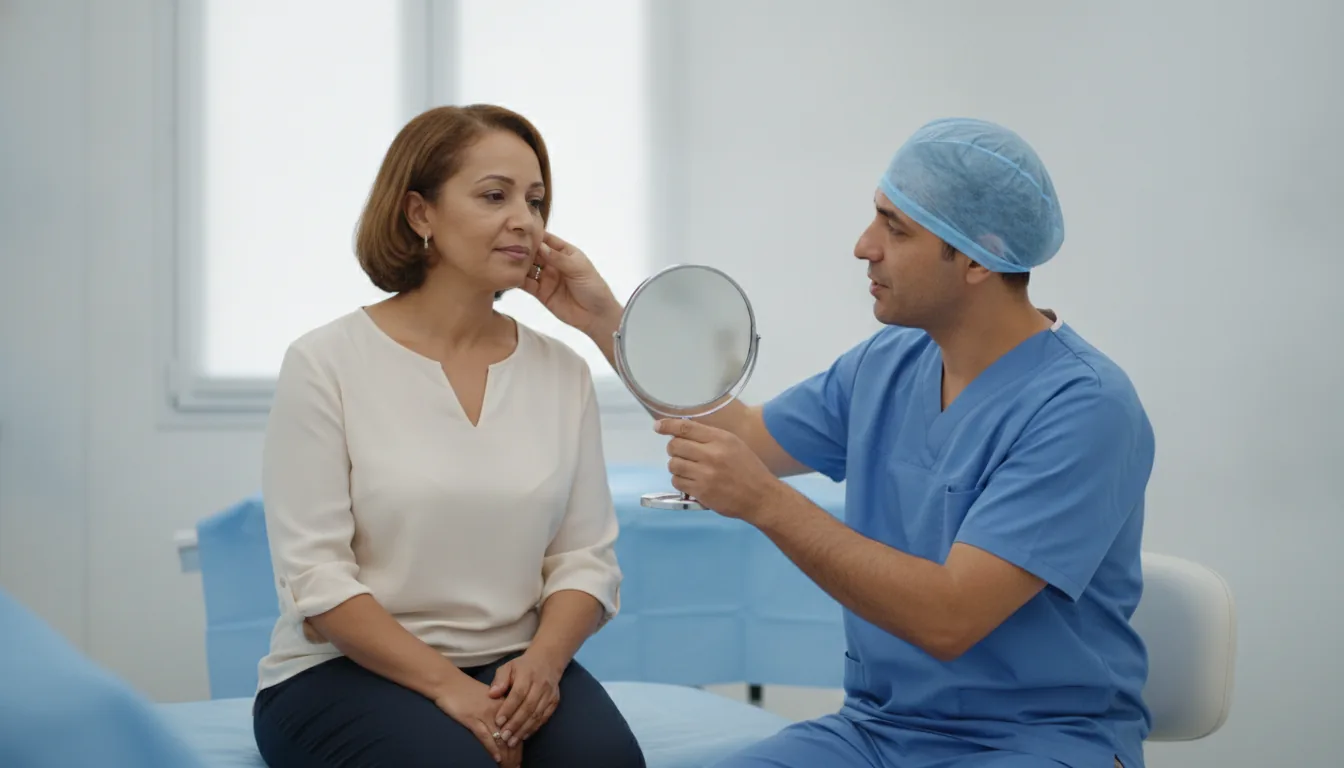
Everything starts with a consultation with the plastic surgeon. They examine your face, take photographs and choose with you the areas to treat and the donor areas for the fat, for example the abdomen, the hips or the inner knees. They take time to listen to your expectations and explain honestly what the technique can achieve and its limits. A reflection period is observed before the procedure is confirmed.
Fat grafting can be performed alone, or at the same time as a facelift or eyelid surgery (blepharoplasty). An anaesthesia consultation is planned depending on the type of anaesthesia chosen. The team then gives you personalised instructions. In general:
- aspirin and anti-inflammatory drugs may need to be stopped, only as instructed by the doctor;
- stopping smoking is advised, as it helps the fat to take;
- any fasting before the procedure follows the anaesthesia team's instructions;
- it helps to plan your return home and a few days of rest in advance.
The day of the procedure
Facial fat grafting is performed under local anaesthesia with sedation, or under short general anaesthesia. It usually lasts one hour to one and a half hours.
The surgeon first harvests the fat through small incisions using a fine cannula. The fat is then prepared, by decantation or gentle centrifugation, to keep only the useful cells. Finally, it is reinjected in very small quantities, layer by layer, with micro-cannulas, so that it spreads evenly. The entry points are closed with a stitch or a simple dressing.
After monitoring in the recovery room, you most often go home the same day. The exact details of your care are agreed in advance with the surgeon and the anaesthetist.
The first days and how volume evolves
After the procedure, the face is swollen and may be bruised for one to two weeks. The donor area may also be tender and marked. Plan to stay away from social activities for a few days.
It is normal for the face to look slightly overfilled at first: this is partly swelling. Part of the injected fat does not survive and is reabsorbed during the first months, which the surgeon takes into account. The final volume can be assessed after three to six months. The fat that has taken then behaves like the surrounding tissue and ages with you. A second session is sometimes needed to achieve the desired volume.
A few tips are often given for a comfortable recovery. They are only indicative: always follow your surgeon's instructions.
- sleep with your head slightly raised for the first few days;
- avoid massaging or pressing on the treated areas without the surgeon's approval;
- avoid physical exertion and sport until you are given the go-ahead;
- protect your face from the sun;
- do not smoke while the fat is taking.
Risks and warning signs
Like any procedure, fat grafting carries risks, which the surgeon explains before operating: swelling and bruising of the face and donor area, reabsorption of part of the fat that may require a second session, small irregularities or asymmetries, which can usually be corrected. Infection or an oil cyst are rare.
Results vary from person to person: they depend in particular on the quality of the tissues and on how well the fat takes. Fever, redness or pain that gets worse, unusual swelling or any symptom that worries you should prompt you to contact the team caring for you without delay.
Coming from abroad? Clinique Pasteur Tunis supports international patients: online quote request, scheduling of consultation and surgery dates, and communication in French, English or Arabic.
Frequently asked questions
Where does the fat used for facial fat grafting come from?
The fat is taken from an area where there is an excess, most often the abdomen, the hips or the inner knees. The donor area is chosen during the consultation with the plastic surgeon.
How long does the procedure take?
Facial fat grafting usually lasts one hour to one and a half hours, under local anaesthesia with sedation or short general anaesthesia. You most often go home the same day.
When can I return to social activities?
The face is swollen and may be bruised for one to two weeks. Plan to stay away from social activities for a few days; the surgeon will tell you the right timing for your case.
Is a second session sometimes needed?
Yes, it happens. Part of the injected fat is reabsorbed during the first months. The final volume can be assessed after three to six months, and a second session is sometimes offered to achieve the desired volume.
Can fat grafting be combined with a facelift?
Yes. A facelift tightens sagging tissue but does not restore lost volume: the two procedures are often complementary and can be performed in the same operation, as can eyelid surgery. The surgeon will discuss this with you during the consultation.
This article is for general information only. It does not replace the advice of your doctor, who alone can adapt instructions to your situation.
Learn more
A question? A quote?
Our team answers your questions and supports you throughout your care journey.