
Coronary CT angiography (CT of the coronary arteries)
Centres/Radiology/CT scan/Coronary CT angiography

Coronary CT angiography (CT of the coronary arteries)

Coronary CT angiography in Tunis, Tunisia · Centre Urbain Nord

Coronary CT angiography in Tunis: CT scan of the heart arteries with an iodinated injection, to look for narrowing without a catheter.

What is it?

Coronary CT angiography is a CT scan of the heart that shows the coronary arteries, which supply the heart muscle. It can look for plaques and narrowing of these arteries without inserting a catheter, unlike coronary angiography. It is requested by the cardiologist, for example for chest pain when the probability of coronary artery disease is considered low to intermediate, before certain surgeries, or to check bypass grafts, depending on their judgement. A normal result often rules out significant coronary artery disease. The examination requires an iodinated contrast injection and a slow, regular heartbeat: a medicine that slows the heart (beta-blocker) may be given beforehand, according to medical advice. At the cardiologist's request, a calcium score (a measurement, without injection, of the amount of calcium deposited in the arteries) can be calculated during the same examination.

When is it indicated?

Chest pain

When the probability of coronary artery disease is low to intermediate, a normal result often rules it out without an invasive test.

Assessment before certain surgeries

Depending on the cardiologist's opinion, it checks the coronary arteries, for example before heart valve surgery.

Checking bypass grafts

It can check that coronary bypass grafts are open, depending on the cardiologist's opinion.

Inconclusive stress test

When a functional test is doubtful, it provides a direct image of the arteries.

Preparation

1Tell us if you are pregnant or think you might be: a CT scan uses X-rays
2If an injection is planned, tell us about any allergy (especially to an iodinated contrast agent), kidney disease, diabetes or myeloma; a recent blood test (creatinine) may be requested
3Tell us if you take metformin (a diabetes treatment): whether to pause it around the injection is decided by the doctor
4If an injection is planned, do not eat for a few hours beforehand, as instructed when you book; your usual medicines can generally be taken with a little water
5Avoid coffee, tea, energy drinks and smoking before the examination, as instructed when you book: they speed up the heart
6Tell us about asthma, a heart rhythm disorder and any erectile dysfunction medicines (incompatible with a medicine sometimes given during the examination)
7Bring your referral, your list of medicines, and your latest ECGs and heart tests

Procedure

1

Your heart rate is checked; a medicine to slow the heart may be given according to medical advice

2

Electrodes are placed on your chest to synchronise the images with your heartbeat

3

You lie on your back with your arms above your head; a medicine under the tongue may be given to widen the arteries

4

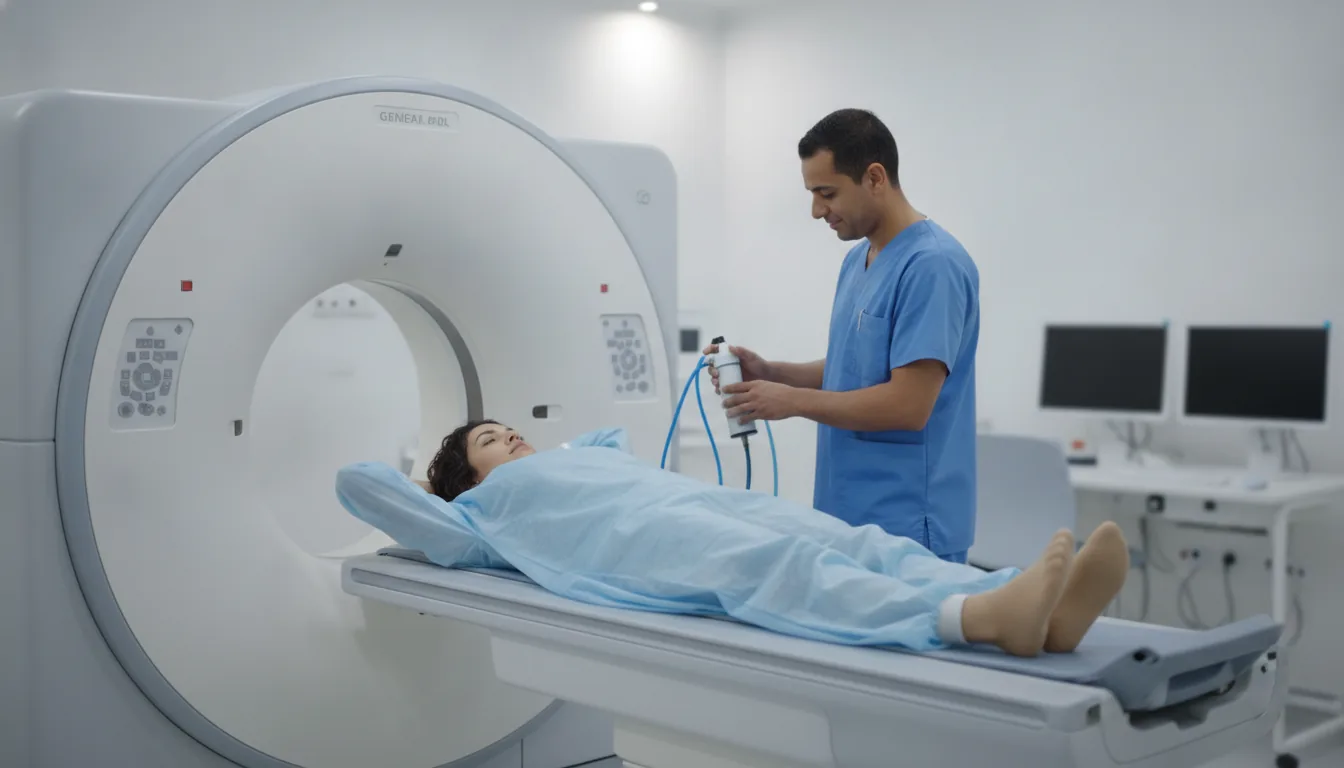
You lie on a table that slides slowly through a wide, open ring: it is not a closed tunnel

5

You practise the breath-hold instruction (holding your breath for a few seconds) before the acquisition

6

If an injection is needed, the iodinated contrast agent is given through a small drip in your arm: a brief feeling of warmth and a metallic taste are normal

7

You can then return to your usual activities; after an injection, drink plenty of fluids during the day (unless your doctor advises otherwise) to help clear the contrast agent

Duration

About 20 to 30 minutes in total, including preparation; the acquisition itself only takes a few seconds

Results

The images are analysed by a radiologist, who writes a report. The report is given to you with the images and sent to your doctor, who will explain the results and the next steps. You will be told when to expect it on the day of the examination.

Precautions and contraindications

A CT scan uses X-rays: the dose is set as low as possible while still giving useful images, and the examination is only done when it is justified
Pregnancy: a relative contraindication; a CT scan is only performed if it is essential, after medical advice
Allergic reaction to the iodinated contrast agent (if injected): rare and usually mild (redness, itching); serious reactions are exceptional and the team is trained to manage them
In case of kidney failure, the iodinated injection can strain the kidneys: the doctor avoids or adjusts it
With an irregular or very fast heart rhythm, image quality may be lower; the doctor may suggest another test
The medicine that slows the heart can cause temporary tiredness; the one given under the tongue can cause a brief headache

Your doctor and the radiology team will inform you in detail before the examination. Feel free to ask them your questions.

This information is general and does not replace the advice of your doctor, who chooses the examination suited to your situation.

Related searches

  • Coronary CT angiography Tunis
  • Coronary CT angiography Tunisia
  • Coronary CT angiography in Tunisia
Request a quoteBook an appointment