
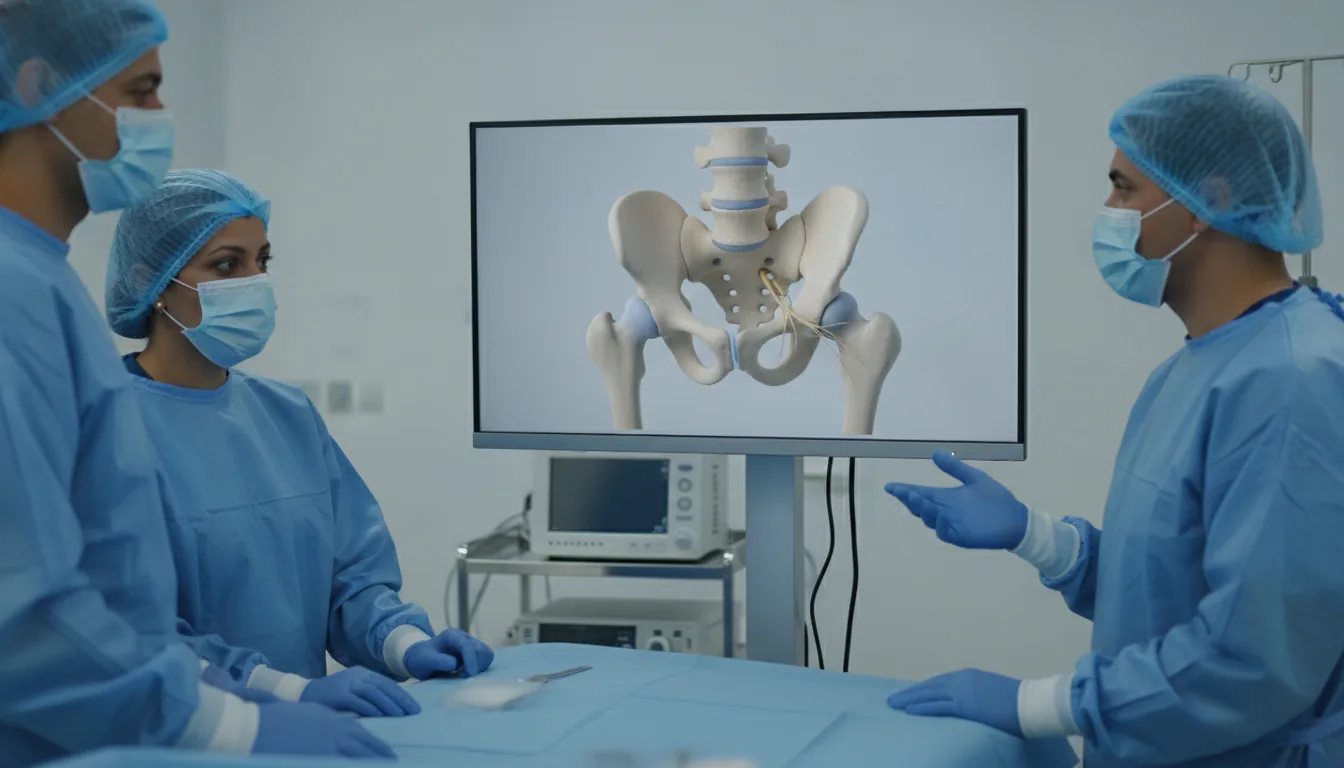
Lumbar disc herniation surgery
Surgeries/Neurosurgery/Lumbar disc herniation

Lumbar disc herniation surgery

Lumbar disc herniation in Tunis, Tunisia · Centre Urbain Nord

Removal of the disc fragment pressing on a nerve in the lower back, to relieve persistent sciatica or femoral nerve pain.

What is it?

Between each pair of vertebrae lies a disc that cushions movement. With age or after strain, this disc can tear and part of its contents can bulge backwards: this is a disc herniation (slipped disc). In the lower back (lumbar region), it presses on a nerve root and causes pain that travels down the leg, called sciatica or femoral nerve pain depending on the nerve affected. In most cases, the pain improves within a few weeks with medical treatment: painkillers, relative rest, physiotherapy and sometimes an injection. Surgery is only offered when pain persists despite this treatment, or straight away in case of paralysis or bladder problems. The operation, called a discectomy, is done through a small incision in the lower back, using an operating microscope or an endoscope. The surgeon gently moves the nerve aside and removes only the disc fragment pressing on it. The rest of the disc is left in place. At Clinique Pasteur Tunis, MRI and electromyography can be performed on site, and the operation takes place in the operating theatre with a short hospital stay. The surgeon explains which movements to avoid and the stages of returning to normal activity.
Lumbar disc herniation surgery

When is it indicated?

Persistent sciatica or femoral nerve pain

Pain travelling down the leg that persists after several weeks of well-conducted medical treatment.

Unbearable pain

Pain that even strong medication does not control (so-called hyperalgic sciatica).

Weakness of a leg muscle

Difficulty walking on the heels or on tiptoe: the nerve is suffering and should be released promptly.

Bladder problems or numbness around the genitals and buttocks

Signs of severe compression (cauda equina syndrome): this is a surgical emergency.

Herniation confirmed on MRI

The images must match the symptoms for the operation to be helpful.

Preparation

1Recent lumbar MRI, sometimes a CT scan
2Consultation with the neurosurgeon
3Anaesthetic consultation
4Tell the team about your medication, especially blood thinners
5Nothing to eat for 6 hours before surgery

Procedure

1

General anaesthesia

2

Positioning face down

3

X-ray localisation of the correct disc

4

Small incision in the lower back

5

Removal of the disc fragment under a microscope or endoscope

6

Closure and dressing

Duration

About 45 minutes to 1 hour 30

Aftercare & Recovery

Patients can usually get up the same day or the next day, and the hospital stay is one to three days. Leg pain often improves quickly; tingling or weakness may take longer. Avoid lifting heavy loads for a few weeks. Office work often resumes after two to four weeks. Physiotherapy may be advised to strengthen the back.

Risks and side effects

Recurrent herniation at the same level, which is possible
Small tear in the nerve covering, repaired during the operation
Infection or haematoma, which are rare
Persistent back or leg pain
Worsening of a nerve deficit, which is exceptional

These risks remain rare. Your surgeon will inform you in detail before the procedure.

Request a Quote

Contact us to schedule a consultation or receive a personalized quote.

Request a Quote +216 36 402 000

At a glance

Duration: About 45 minutes to 1 hour 30
Preparation: Required
Dedicated specialist team

Related searches

  • herniated disc surgery Tunisia
  • discectomy Tunisia
Request a quote