
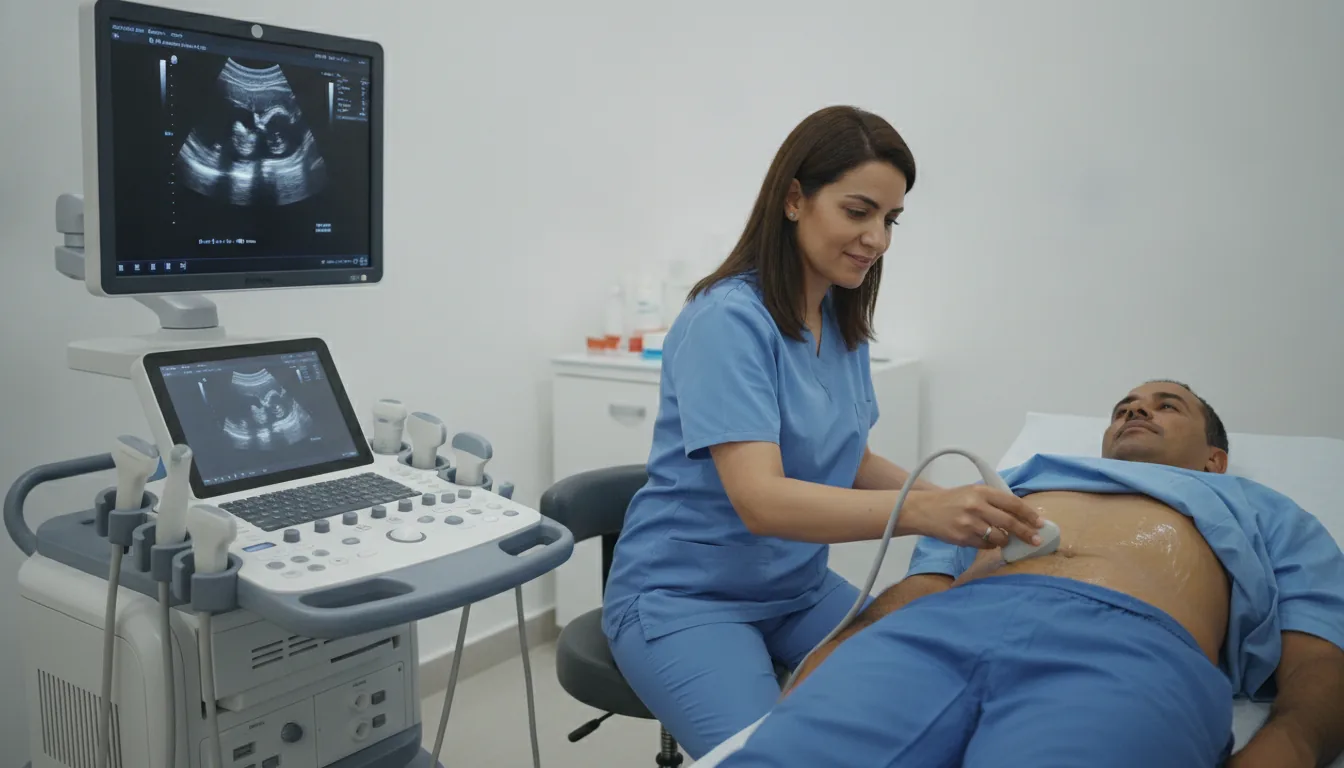
Transcranial Doppler ultrasound
Transcranial Doppler in Tunis, Tunisia · Centre Urbain Nord
Transcranial Doppler in Tunis: measures blood flow in the brain arteries using ultrasound through the temples, without X-rays.
What is it?
When is it prescribed?
It regularly screens children at risk of stroke, so that suitable prevention can be put in place.
It monitors a temporary narrowing of the brain arteries (vasospasm) that can occur in the following days.
It completes the study of the neck arteries by assessing blood flow in the brain arteries.
With a microbubble test, it can help look for an abnormal passage between the heart chambers, alongside a heart ultrasound.
Preparation
How the exam is performed
You lie on your back with your head supported
Gel is applied to the temples, sometimes to the back of the head or over the closed eyelids
The doctor angles the probe to find each artery and measures the blood flow speed
You may hear a rhythmic whooshing sound: this is the sound of blood flowing, picked up by the Doppler
For a shunt test: a small drip is placed in your arm and the microbubble liquid is injected; you may be asked to strain while holding your breath
The gel is wiped off at the end; you can return to your usual activities straight away
Duration
About 20 to 45 minutes
Results
The doctor performing the test (cardiologist, angiologist or radiologist, depending on the referral) analyses the images and measurements during the examination, then writes a report. The report is given to you and sent to your doctor, who will explain the results and the next steps. You will be told when to expect it on the day of the examination.
Risks and side effects
These risks remain rare. Your physician will explain them in detail before the exam.
Request a quote
Request your quote online or call us on the number below:
Request a Quote +216 36 402 034At a glance
Related searches
- Transcranial Doppler Tunis
- Transcranial Doppler Tunisia
- Transcranial Doppler in Tunisia